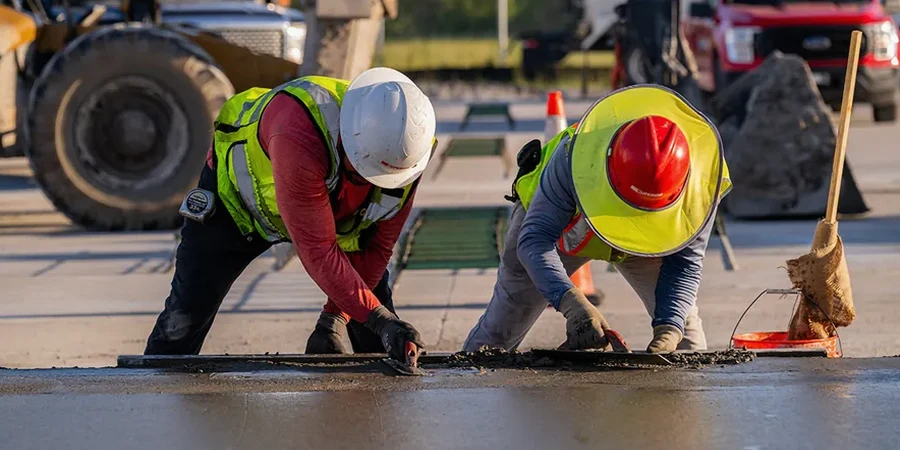
Arlington's location on the Eagle Ford Shale formation presents a unique set of geotechnical challenges for rigid pavement design. The highly expansive clay subgrades common across Tarrant County demand a design approach that goes well beyond standard AASHTO 93 methodology. Our team applies the ACPA StreetPave and FAA FAARFIELD software to model slab response under heavy truck and aircraft loading, ensuring long-term performance. For subgrade characterization, we integrate in-situ permeability testing to assess drainage conditions and CBR road testing for precise modulus inputs, which are critical for determining the required concrete thickness and joint layout.
Controlling joint movement in Arlington's expansive clay requires a solid subgrade reaction modulus, not just an assumed k-value from a table.
Local geotechnical context
The Eagle Ford Shale in Arlington has a liquid limit often exceeding 60 and a plasticity index above 30, classifying it as highly expansive (CH per ASTM D2487). A rigid pavement placed directly on this untreated subgrade is at extreme risk of differential heave during the wet season and shrinkage cracks during the dry summer months. Without a moisture-insensitive, stabilized subbase layer, water infiltration through joints and cracks will saturate the shale, leading to significant pumping of fines and a rapid loss of structural support. The resulting faulting at transverse joints creates a rough, unsafe riding surface that requires costly slab jacking or full-depth panel replacement much earlier than the design life anticipates.
Quick answers
What is the typical design life of a rigid pavement in Arlington?
We typically design for a 20 to 30-year service life. This requires accurate traffic forecasting in ESALs and proper modeling of the Eagle Ford Shale's support conditions over time, including a moisture-conditioned subgrade modulus.
How do expansive clays affect joint performance in rigid pavements?
Expansive clays cause differential volume changes that lead to loss of support at joints. Without a stabilized subbase and proper dowel load transfer, water enters the joint, saturates the clay, and causes pumping and faulting that destroys the ride quality.
How much does a rigid pavement design cost for a commercial project?
For a typical commercial project in Arlington, the rigid pavement design scope ranges from US$1,800 to US$7,220, depending on the traffic data analysis required and the extent of subgrade investigation needed to determine the k-value.
What input data do you need to start the design?
We need a geotechnical report with CBR values, Atterberg limits, and ideally a resilient modulus test on the subgrade. We also require the projected traffic mix, axle load spectra, and any site grading plans that affect drainage and subgrade moisture conditions.