Together, we solve the challenges of tomorrow.
LEARN MORE →In-situ testing forms the backbone of reliable geotechnical engineering in Arlington, Virginia, providing direct measurements of subsurface conditions without the disturbance inherent in laboratory sampling. This category encompasses a suite of field-based investigation methods designed to evaluate soil strength, density, permeability, and deformation characteristics in their natural state. For a region defined by its complex transition between the Piedmont Plateau and the Atlantic Coastal Plain, understanding the real-time behavior of underlying soils and weathered rock is not a luxury—it is a necessity. These tests empower engineers to make informed decisions about foundation design, earthwork quality control, and slope stability, directly mitigating the risks posed by Arlington's notoriously variable ground profile.
Arlington's geology presents a challenging dichotomy that makes comprehensive in-situ testing indispensable. Much of the county is underlain by decomposed metamorphic and igneous rocks of the Piedmont province, specifically the Sykesville Formation and associated granitic intrusions. These materials often manifest as residual soils and saprolite—ground that looks like soil but retains the fabric and unpredictable strength of its parent rock. In other areas, particularly towards the Potomac River, deep alluvial deposits and marine clays introduce risks of consolidation settlement and low bearing capacity. Simply put, a standard split-spoon sample cannot capture the true in-situ density of a micaceous silt or the variable fracture spacing in weathered schist. Field testing bridges this gap, revealing how these formations will actually perform under load.
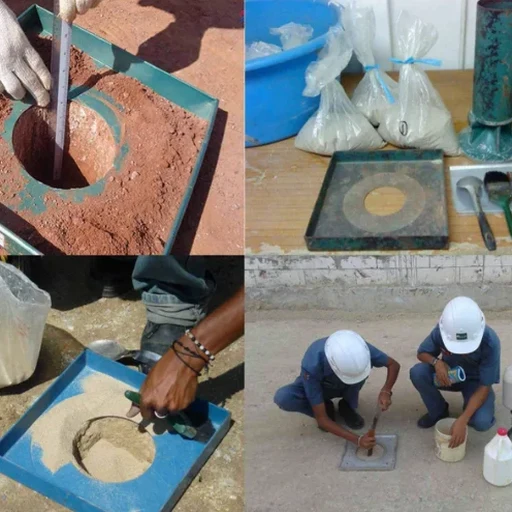
Regulatory compliance in Arlington demands adherence to stringent national and local standards, primarily governed by the Virginia Uniform Statewide Building Code (USBC), which adopts the International Building Code (IBC) with state-specific amendments. Chapter 18 of the IBC mandates that geotechnical investigations be sufficient to evaluate soil strength and compressibility, and local amendments enforced by Arlington County's Inspection Services Division often require verification of fill compaction through direct field measurement. All in-situ testing procedures must conform to ASTM International standards. For instance, a field density test (sand cone method) is routinely required and must strictly follow ASTM D1556 to verify that structural fill achieves the 95% modified Proctor density specified in project documents, ensuring no future settlement beneath pavements or building slabs.
The types of projects requiring these critical field investigations span the full spectrum of Arlington's dense urban development. High-rise commercial buildings in Rosslyn and Crystal City rely on pressuremeter tests (ASTM D4719) and dilatometer tests (ASTM D6635) to design deep foundations socketed into competent rock. Infrastructure projects, including the expansion of Arlington National Cemetery and the county's ongoing stormwater management upgrades, depend on infiltration testing and borehole permeability assessments to meet Chesapeake Bay Preservation Act requirements. Even residential additions and townhouse developments in neighborhoods like Lyon Village frequently trigger the need for a field density test (sand cone method) to sign off on backfill compaction, protecting against differential settlement that plagues older homes.
In-situ testing evaluates soil properties in its natural, undisturbed state directly in the ground, preserving stress conditions, moisture, and fabric. Laboratory tests require extracted samples that can be disturbed during transport, especially in Arlington's sensitive residual soils and saprolite. Field tests like the standard penetration test (SPT) or cone penetration test (CPT) provide a continuous profile of behavior that lab tests alone cannot replicate.
The pressuremeter test (PMT) and dilatometer test (DMT) are highly effective for the decomposed schist and gneiss common in Arlington, as they directly measure modulus and limit pressure. For a continuous profile of strength in saprolitic materials, the cone penetration test with pore pressure measurement (CPTu) can be used where refusal is not encountered, but it may be limited by gravelly zones.
Arlington County, following the Virginia USBC and IBC, mandates field density verification for all engineered fill placed beneath foundations, slabs, and pavements. A minimum frequency, typically one test per lift per 2,500 square feet, is enforced by the special inspections program. The nuclear gauge or sand cone method must prove compaction meets the project's specified relative compaction, usually 95% of the maximum dry density.
In Arlington's micaceous and partially weathered rock residuum, SPT N-values can be misleadingly high due to fabric cohesion or gravel-sized remnants, yet the soil mass may still be compressible. Energy transfer corrections and careful observation of drilling disturbance are critical. Often, CPT data or shear wave velocity measurements are paired with SPT data to calibrate a more reliable interpretation of strength and liquefaction potential.