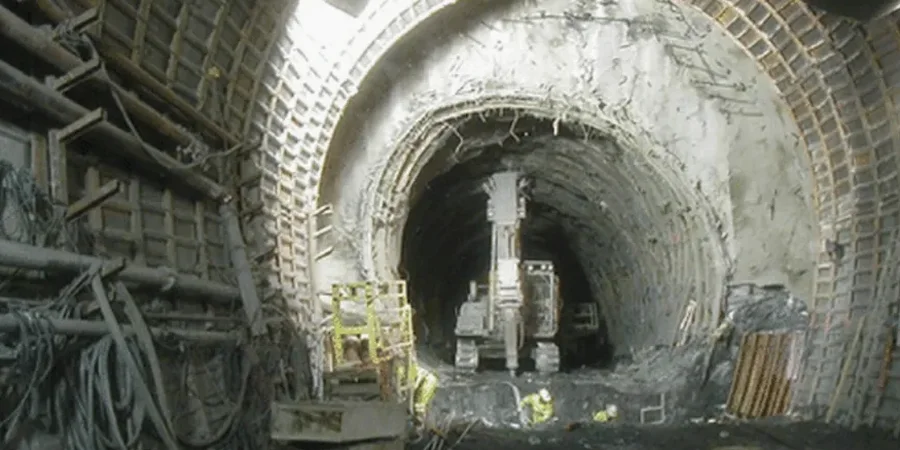
Arlington sits on the Woodbine Formation and Quaternary alluvium, with extensive clay layers that hit plasticity indices above 30 in the upper 15 feet. When the city pushed the AT&T Stadium expansion or the I-30 utility corridors, the sheared shale interfaces defined the tunnel alignment. Our lab runs the consolidation and triaxial tests that set the face pressure for EPB machines in these soft soils. A CPT test gives us continuous tip resistance and pore pressure data without disturbing the sample, which is critical in the interbedded sands we find near Johnson Creek. For mixed-face conditions we also correlate the data with seismic refraction to map the top of rock before the TBM hits a transition zone.
In Arlington's Eagle Ford, a free swell above 80 percent changes the ground reaction curve and the required face pressure completely.
Methodology and scope
In Arlington we often see tunnel contractors underestimate the swelling potential of the Eagle Ford when it gets wet. The montmorillonite content can push free swell above 80 percent, and that changes the ground reaction curve completely. We run oedometer tests on undisturbed Shelby tube samples to measure the swelling pressure directly, then feed that into the convergence-confinement analysis. The lab sequence includes classification per ASTM D2487, Atterberg limits, and CU triaxials with pore pressure measurement to define effective stress parameters at the tunnel depth—usually between 20 and 60 feet for Arlington's storm drainage and utility tunnels. The data package goes to the designer with clear recommendations on pre-support, face reinforcement, and ring closure distance.
Quick answers
What lab tests are required for a soft ground tunnel in Arlington?
The core program includes Atterberg limits, particle size distribution, CU triaxial with pore pressure measurement, one-dimensional consolidation, and swell pressure testing. If the alignment crosses sand lenses, we add permeability tests. All testing follows ASTM D4767, D2435, and D4546, with results reported per IBC Chapter 18 requirements for the City of Arlington permit review.
How do you determine the TBM face pressure for Arlington's clay soils?
We use the undrained shear strength from UU triaxial tests and the effective friction angle from CU triaxials to model the face stability. The lab data feeds a limit equilibrium or numerical model that calculates the minimum face pressure to prevent blowout in the alluvium or collapse in the Eagle Ford. Typical values for Arlington's utility tunnels range from 1.5 to 3.0 bar depending on depth and groundwater.
How much does a geotechnical lab program for a tunnel project cost?
For a tunnel project in Arlington, the lab testing program typically ranges from US$4,500 to US$15,730 depending on the number of borings, sample depth, and the test suite selected. A basic program with Atterberg limits, UU triaxials, and consolidation on 6 to 10 samples runs at the lower end, while a full program adding CU triaxials, swell pressure, and permeability on 20-plus samples moves toward the upper range.
What is the biggest geotechnical risk for tunneling in Arlington's Eagle Ford Shale?
The swelling potential is the dominant risk. When the Eagle Ford is exposed to water during tunnel excavation, the montmorillonite content can generate swell pressures exceeding 5 psi, which distorts the segmental lining and delays ring closure. We quantify this with swell pressure tests per ASTM D4546 and recommend pre-support or drainage measures to mitigate the effect before the TBM advances.