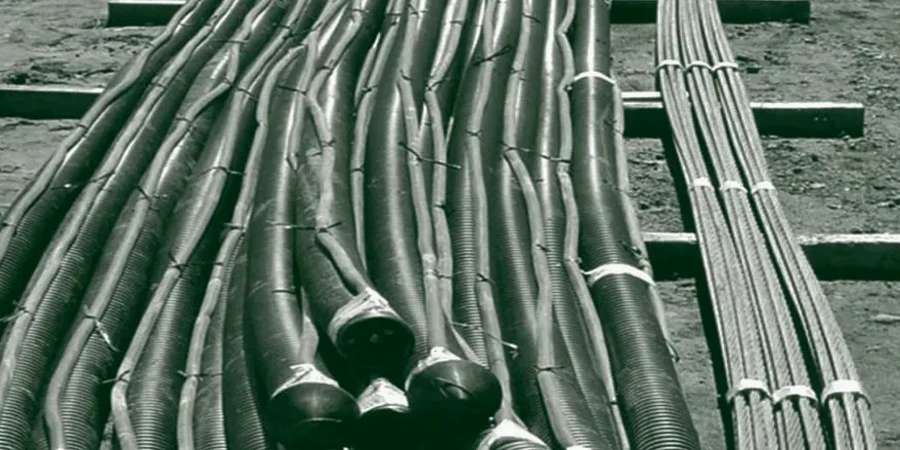
One of the costliest mistakes a contractor can make in Arlington is assuming that a standard tieback detail from another region will perform identically in the stiff, overconsolidated clays of the Eagle Ford Formation. We have seen projects where anchor bond zones were undersized because the design relied on generic friction values that do not account for the slickensided surfaces and moisture-sensitive behavior of these local soils. Proper anchor design here demands a clear distinction between active tendons—which are stressed to control wall deflection from the outset—and passive elements that only engage once the retained soil mass begins to move. By integrating site-specific in-situ permeability testing into the pre-design phase, we quantify the drainage characteristics that govern long-term pore-water pressure buildup behind the wall, a factor that directly influences the corrosion protection requirements and the free-length calculation for each anchor.
In Arlington's Eagle Ford shale, anchor capacity is governed more by the persistence of slickensides than by the intact rock strength—neglecting this leads to bond lengths that look correct on paper but fail under proof testing.
Quick answers
How much does anchor design and testing cost for a typical Arlington retaining wall project?
For a standard project requiring site investigation review, anchor load calculations, bonded and unbonded length design, and on-site proof testing supervision, the investment ranges from US$1,010 to US$3,650. The exact figure depends on the number of anchor rows, whether sacrificial testing is required, and the complexity of the ground profile. We recommend budgeting toward the upper end if the site is in the alluvial terraces near the Trinity River where variable stratigraphy demands a more intensive verification program.
What is the difference between active and passive anchors in a retaining wall?
Active anchors are tensioned during installation to a predetermined lock-off load, which immediately compresses the soil mass behind the wall and minimizes lateral deflection. This makes them suitable for situations where adjacent structures or utilities cannot tolerate movement. Passive anchors are not prestressed; they develop resistance only when the soil begins to displace and mobilize the bond zone. In Arlington, we often specify active anchors in the dense urban corridors and passive systems for temporary slope stabilization in less constrained areas.
Are permanent ground anchors subject to special corrosion protection requirements in Texas?
Yes, permanent anchors that will remain in service beyond 24 months must meet Class I corrosion protection as defined by PTI DC35.1 and FHWA-RD-97-130. This involves a double-corrugated sheathing over the tendon free length, a grout cover of at least 0.5 inches over the steel in the bond zone, and the use of end caps filled with corrosion-inhibiting compound. In Arlington's expansive clays, we also specify a slightly thicker grout cover because crack propagation during seasonal wet-dry cycles can create preferential pathways for moisture and oxygen to reach the steel.
What drilling methods work best for anchor installation in Arlington's Eagle Ford shale?
Rotary duplex drilling with an eccentric bit is generally the most reliable method in the weathered shale and interbedded limestone layers found across Arlington. The duplex system allows the casing to advance simultaneously with the drill bit, preventing the borehole from collapsing in fissured zones or when encountering groundwater in the alluvial terraces. Open-hole rotary drilling is feasible in the more competent shale sections south of I-20, but we always recommend a trial anchor to confirm that the hole stays open long enough to insert the tendon and complete the grouting without blockages.
How many proof tests are required for a typical anchored wall project?
The IBC and PTI guidelines require proof testing on a minimum of 5% of production anchors, with at least three anchors tested on any project. In Arlington, where the shale can exhibit highly variable bond stress over short distances, we often increase this to 10% on the first row of anchors and include one sacrificial test to failure per distinct soil unit. The proof test holds the anchor at 133% of the design load for 10 minutes while monitoring creep; a creep rate exceeding 0.04 inches per log cycle of time typically triggers a re-evaluation of the bond zone design.