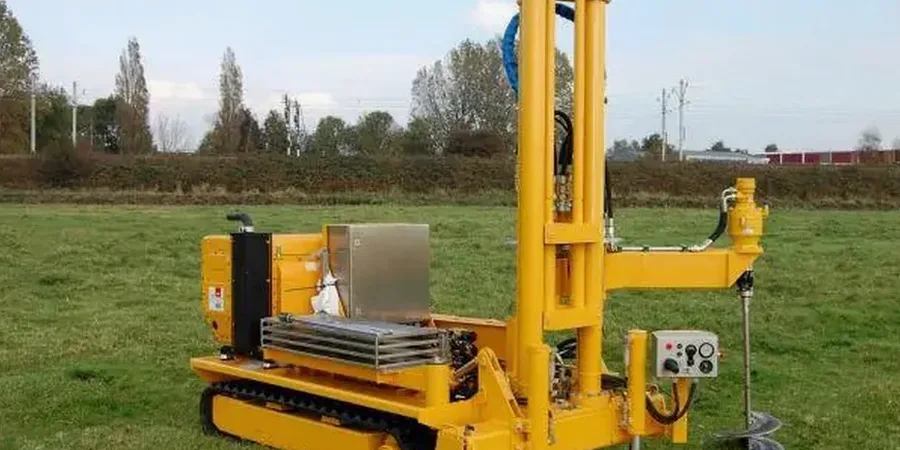
When drilling through the stiff, desiccated clays north of I-30 in Arlington, standard penetration tests often struggle to capture the subtle layering that governs foundation performance. The Cone Penetration Test (CPT) eliminates that blind spot by providing a continuous, high-resolution profile of tip resistance and sleeve friction without the disturbance of a borehole. Our laboratory processes that raw cone data against local stratigraphic markers—the Woodbine Formation, the Eagle Ford Shale, and the overlying terrace deposits—so the engineering team receives a stratigraphic log calibrated to Arlington’s specific geology, not a generic textbook column. For projects near Johnson Creek or the Trinity River floodplain, pairing CPT soundings with a liquefaction assessment early in the investigation flags potentially liquefiable silts before they surprise you during excavation. In the expansive clay zones that dominate central Arlington, the pore pressure dissipation tests we run with the piezocone give a direct measurement of consolidation behavior that a Shelby tube sample simply cannot match.
A single CPT sounding in Arlington’s interbedded clays and sands gives more stratigraphic detail than three standard boreholes.
Local geotechnical context
A five-story mixed-use structure on Abram Street had a settlement problem that traditional borings missed entirely. The geotechnical report logged the upper 15 feet as stiff tan clay with sand seams, but differential settlement appeared within six months of completion. When we returned with a piezocone rig and pushed three CPT soundings 60 feet deep, the continuous sleeve friction trace revealed a 2-inch-thick, normally consolidated silt lens at 22 feet that the split-spoon samples had simply washed through. That single soft layer, undrained during the rapid construction loading, was compressing asymmetrically under the east wing. Arlington’s Pleistocene terrace deposits are full of these thin, discontinuous soft zones—relict channel fills and oxbow deposits from the ancestral Trinity River system—that only a continuous profiling method like CPT can resolve. Without that resolution, you are designing on an assumption, not a stratigraphic fact.
Quick answers
How deep can you push a CPT sounding in Arlington’s Eagle Ford Shale?
Refusal typically occurs when the cone encounters the weathered shale bedrock, which in Arlington can range from 25 to 55 feet below grade depending on the terrace elevation. Our 20-ton rig achieves refusal at cone resistances exceeding 100 to 120 MPa. We do not recommend pushing through the massive, unweathered Eagle Ford limestone stringers because the risk of cone damage escalates quickly. For deeper profiles requiring penetration into shale, a pre-drill through the hard layer followed by CPT below the obstruction is the practical approach.
What does a CPT test cost for a typical Arlington residential lot?
For a standard single-family lot investigation in Arlington, CPT soundings usually run between US$190 and US$250 per location, depending on depth, access constraints, and whether piezocone or seismic cone modules are required. A typical program of two to three soundings with dissipation tests provides sufficient coverage for foundation design on most residential parcels.
How does CPT compare to SPT for foundation design in expansive clays?
In Arlington’s expansive Eagle Ford clays, CPT provides a continuous strength profile that reveals thin sand seams and fissures controlling drainage and swell behavior—features that standard SPT sampling at 5-foot intervals misses entirely. The friction ratio and pore pressure response from a piezocone also help identify the active zone depth and the degree of overconsolidation, which directly influences heave predictions. SPT is better suited for gravelly layers where the cone risks refusal, so we often combine both methods on the same site.
Can you perform CPT testing inside an existing building with limited headroom?
Yes, we operate low-headroom CPT rigs that can work under 8-foot ceilings and through standard door openings. These units use shorter rod segments and a segmented push system. The trade-off is a reduced maximum push force—typically 10 tons instead of 20—so refusal depth in Arlington’s stiff clays may be shallower than with a full-size rig. We assess access conditions during the site walk before confirming the achievable depth.
How long does a CPT investigation take for a commercial site in Arlington?
A typical commercial site investigation with four to six CPT soundings to 50 feet depth can be completed in one field day, assuming reasonable access and no buried utilities that require potholing. Data processing and the interpretive report with SBTn classification and engineering parameters are delivered within three business days after the field work. Sites requiring seismic cone measurements or extensive dissipation testing may need a second day.