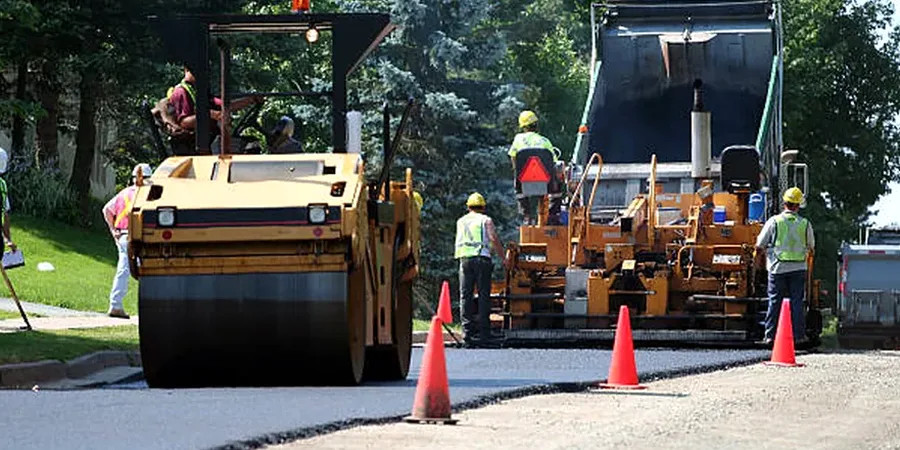
A few years back, we were called to look at a parking lot off Cooper Street that had turned into a washboard after just two summers. The asphalt was riddled with alligator cracking, and the owner couldn't understand why — the pavement section looked thick enough on paper. What the original design missed was Arlington's subgrade reality: highly plastic Eagle Ford clay that swells with winter moisture and shrinks dramatically during our 100-degree August afternoons. A flexible pavement here isn't just a structural section; it's a moisture management system. The subgrade support can drop by half between March and September, and if your CBR pavement design doesn't reflect that seasonal swing, you'll be repaving within three years. We've seen it too many times to count.
In Arlington, a pavement designed without accounting for seasonal subgrade moisture variation is a pavement designed to fail within five years.
Local geotechnical context
The pavement design challenge varies noticeably between North and South Arlington. Up around River Legacy Park, the alluvial soils near the Trinity River bring a higher water table and more silt, so we worry about pumping and loss of base support during wet cycles. Down south near the Parks Mall area, the issue is almost purely expansive clay — the soil can swell enough to lift a poorly designed pavement section by over an inch, then shrink back and leave a void underneath the asphalt layer. The risk isn't just cracking; it's differential movement at joints with rigid pavement transitions and around drainage inlets. We've also seen cases where a flexible pavement design imported from a generic Texas manual didn't account for the thermal gradient specific to Arlington, where surface temperatures can hit 140°F. That kind of heat softens the asphalt binder and accelerates rutting in the wheel paths. A proper mix design with polymer-modified binder, tied to a subgrade that has been stabilized and proof-rolled, is the only way to avoid the maintenance headaches we keep seeing on older commercial properties.
Relevant standards
AASHTO Guide for Design of Pavement Structures (1993), AASHTOWare Pavement ME Design (2020), TxDOT Standard Specifications - Item 300 Series, ASTM D1883 Standard Test Method for CBR, ASTM D4318 Standard Test Methods for Liquid Limit, Plastic Limit, and Plasticity Index of Soils
Quick answers
What does flexible pavement design cost for a commercial project in Arlington?
For a typical commercial parking lot or small access road in Arlington, the geotechnical investigation and pavement design package runs between US$1,680 and US$4,460, depending on the number of borings, the extent of laboratory testing required, and whether lime stabilization mix design is included.
Why does Arlington's soil require special consideration for asphalt pavement?
The Eagle Ford formation under much of Arlington is a high-plasticity clay with significant swell-shrink potential. When this soil gets wet, its bearing capacity drops sharply, and the volume change can lift or undermine an asphalt section. Without stabilization, the pavement life can be cut in half compared to designs on more forgiving soils.
How many soil borings are needed for a pavement design project?
We typically follow TxDOT guidelines, which call for borings every 200 to 300 feet along the alignment for roadways, with a minimum of three borings for a parking lot under one acre. The borings should extend at least five feet below the proposed subgrade elevation to capture any deeper moisture-sensitive layers that could affect long-term performance.