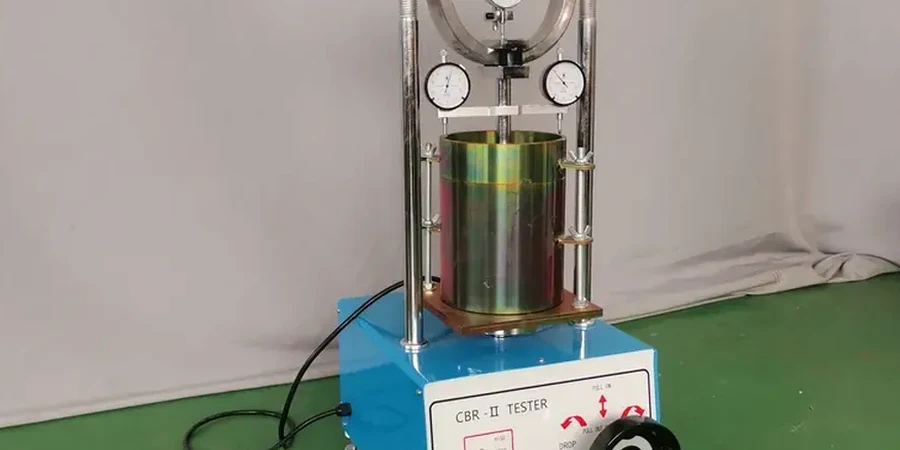
The subgrade under Cooper Street and the soils out near Lake Arlington behave nothing alike. You get stiff Eagle Ford shale in some pockets, and then a stretch of sandy loam that turns to mush after a good North Texas rain. That difference is exactly why a standard Proctor number alone won't cut it for pavement design. The laboratory CBR test gives you a direct measure of the soil's bearing capacity under controlled moisture and density conditions, which is what really matters when you're laying down asphalt or concrete that has to survive 100-degree summers, flash floods, and the constant truck traffic on I-20 frontage roads. Our team runs both soaked and unsoaked California Bearing Ratio tests on remolded samples, following the AASHTO T 193 procedure step by step.
A soaked CBR value of 6 versus 12 changes your pavement section by three inches of asphalt, and in Arlington that can mean fifty thousand dollars difference on a commercial parking lot.
Local geotechnical context
Tarrant County sits on the Woodbine Formation, a Cretaceous sandstone and shale unit that weathers into highly plastic clay residuum across much of Arlington. The natural moisture content in these clays often sits near the plastic limit during dry months, but a single wet construction season can push it past the liquid limit, cutting the soaked CBR to less than 3. That puts your pavement structure at risk of rutting, alligator cracking, and base failure within the first two years. A laboratory CBR test run at the target density and worst-case moisture scenario reveals this weakness before the asphalt plant ever fires up. We see projects around the Viridian and Lake Arlington areas where the difference between a properly soaked CBR and a quick field estimate translates into an extra 30% on the pavement budget.
Quick answers
How much does a laboratory CBR test cost in Arlington?
A standard one-point soaked CBR test in our Arlington lab runs between US$130 and US$230, depending on whether you need a three-point family, additional moisture content points, or expedited turnaround. We quote a firm price once we know the sample condition and the number of molding points required.
What is the difference between soaked and unsoaked CBR?
An unsoaked CBR tells you the strength at the compaction moisture content right after molding, which is optimistic for most Arlington soils. A soaked CBR simulates the subgrade after prolonged wet weather or a rising water table by submerging the specimen for 96 hours under surcharge weights. The soaked value is almost always lower, and it is the number used for pavement thickness design per AASHTO 93.
Can you run a CBR test on aggregate base material?
Yes, we test crushed limestone base, flex base, and recycled concrete aggregate for CBR. The procedure is the same AASHTO T 193, but the compaction energy may shift to a modified Proctor and we use a larger surcharge weight to represent the structural pavement section. Base materials in Arlington quarried from the Whitestone formation typically yield CBR values above 80 when properly graded.
How long does a laboratory CBR test take from sample drop-off to report?
A standard soaked CBR test requires four days for the soaking phase alone, plus compaction, setup, and penetration testing. Typical turnaround in our Arlington lab is six to seven business days. We can expedite to five days for an additional fee if your paving schedule is tight and the sample is already in-house.