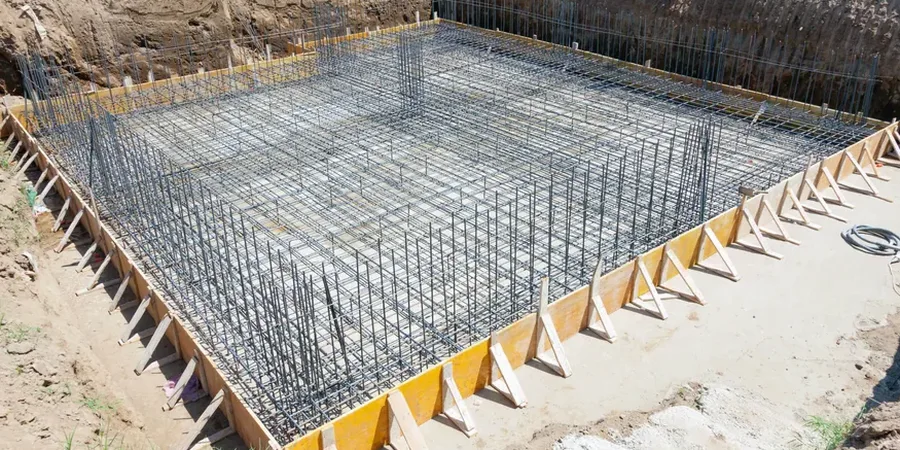
The single most expensive mistake we see on Arlington job sites is pouring a thick, heavily reinforced mat foundation over expansive clay without quantifying the swell pressure first. Arlington sits squarely on the Eagle Ford Shale and Quaternary terrace deposits — formations famous across North Texas for their high plasticity and seasonal volume swings. A mat foundation can absolutely manage these movements, but only if the design matches the actual soil profile. You need more than a generic allowable bearing pressure of 2,000 psf pulled from a county report. We combine deep borings with laboratory swell-consolidation curves to define the stiffness and heave potential under the entire footprint. For irregularly shaped commercial slabs, we often pair the mat analysis with a targeted CPT test program to map soft lenses without the delays of conventional drilling, giving the structural engineer a continuous stratigraphic profile that no SPT-only log can match.
A well-designed mat foundation in Arlington clay doesn’t eliminate movement — it distributes it across a stiffened plate with predictable edge heave and controlled angular distortion.
Local geotechnical context
The 32.7356°N, 97.1071°W coordinates place Arlington in a region where the static water table can fluctuate 10 feet between August and February, and where the local clay has liquid limits routinely exceeding 55%. Skip the swell test, and your mat becomes a liability: edge-lift heave can crack masonry walls in the first dry summer, while center-lift cycles during re-wetting tear interior partitions and bind doors. We’ve also measured sulfate concentrations above 0.3% in groundwater samples taken from depths of 8 to 14 feet in the central Arlington area, which triggers Type V cement requirements per ACI 318 exposure class S2. Add the seismic demand from ASCE 7-22 site class D profiles, and you realize a mat foundation in Arlington is an engineered system — not a cookie-cutter slab. The liquefaction potential in sandy paleochannel deposits near the Trinity River tributaries is another factor we evaluate with SPT-based triggering analyses when designing deep mats for critical facilities.
Quick answers
What is the typical design life of a raft foundation in Arlington’s expansive clay?
With proper geotechnical characterization and construction quality control, a mat foundation designed to PTI DC10.5 criteria can perform for 50 years or more. The key is limiting angular distortion below 1/480 for brittle finishes and ensuring the stiffening beam layout matches the predicted heave pattern. We specify sulfate-resistant cement and minimum cover requirements that protect reinforcement against corrosion even in the moderately aggressive soils found across Tarrant County.
How does a mat foundation differ from a conventional spread footing system in Arlington conditions?
A mat distributes structural loads across the entire building footprint rather than concentrating them at isolated column locations. In Arlington’s high-plasticity clays, this reduces differential settlement because the entire slab moves as a rigid unit. Spread footings, by contrast, can experience independent heave cycles that rack the superstructure. Mats also eliminate the need for deep drilled piers in many cases, simplifying excavation and reducing the number of trade interfaces on site.
What does a raft foundation design package cost for a small commercial building in Arlington?
For a typical light commercial structure up to 5,000 square feet, the combined geotechnical investigation and mat foundation design package ranges between US$1,000 and US$3,770, depending on the number of borings required and the complexity of the soil-structure interaction analysis. Larger footprints or sites with irregular geology fall toward the upper end of that range.
How long does it take to complete a mat foundation design after the soil investigation?
A standard timeline runs 3 to 4 weeks from the completion of field drilling: one week for laboratory swell and consolidation testing, one week for geotechnical modeling and parameter selection, and one to two weeks for finite element analysis and report preparation. Expedited schedules are possible when the laboratory can prioritize the consolidation phase and the structural engineer is ready to start the mat layout in parallel.