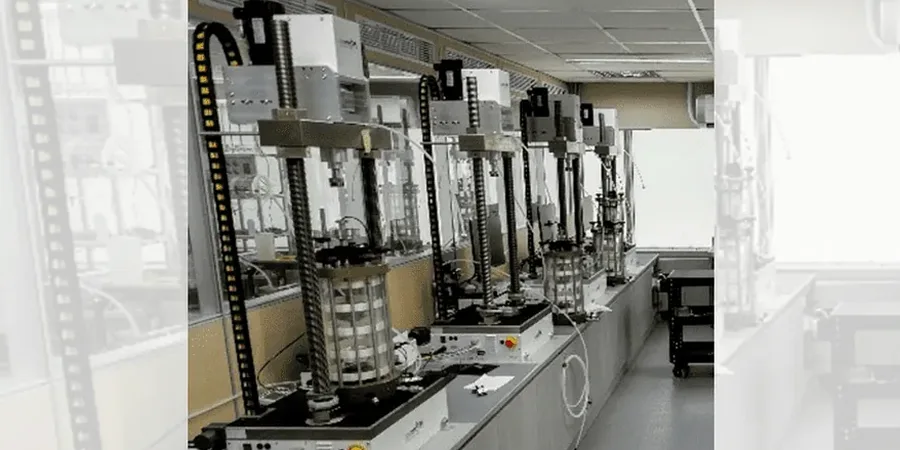
Arlington sits on a complex interface between the Woodbine Formation and the expansive Eagle Ford Shale, and we see the consequences in the lab every week. A split-spoon sample from a boring off Cooper Street might look intact in the field, but the triaxial cell tells a different story once confining pressure matches the actual overburden. For critical infrastructure near AT&T Stadium or the growing industrial corridors along I-20, assuming textbook cohesion values from a pocket penetrometer is not enough. We run consolidated-undrained (CU) and unconsolidated-undrained (UU) tests because the failure envelope you get from a CPT test tip resistance correlation needs laboratory validation when the project involves deep excavations or heavily loaded footings on residual clay. That is where a proper triaxial program pays for itself.
An effective friction angle of 22 degrees in weathered Eagle Ford Shale is common in Arlington, but the actual value can range from 18 to 28 depending on preconsolidation history and carbonate cementation.
Local geotechnical context
The contrast between the flat, alluvial areas near the Trinity River and the rolling terrain south of I-20 in Arlington creates distinct geotechnical risk profiles. On the floodplain, normally consolidated clays and silts can exhibit contractive behavior in undrained triaxial shear, generating positive excess pore pressures and a significant reduction in undrained shear strength. In a CU test, this appears as a friction angle of 18 to 22 degrees with zero effective cohesion intercept. Just three miles south, the shale-derived residual soils in the Dalworthington Gardens area often show overconsolidated behavior with dilative tendencies during shear. Peak friction angles here can reach 26 to 28 degrees, but post-peak softening can drop that to 20 degrees or less at large strains. Using a single design strength for the entire city without differentiating between these two soil responses leads to either overconservative footings or underpredicted settlement. The triaxial test is the only routine laboratory method that can separate these behaviors before construction starts.
Relevant standards
ASTM D2850-15: Standard Test Method for Unconsolidated-Undrained Triaxial Compression Test on Cohesive Soils, ASTM D4767-11: Standard Test Method for Consolidated Undrained Triaxial Compression Test for Cohesive Soils, ASTM D7181-20: Standard Test Method for Consolidated Drained Triaxial Compression Test for Soils, AASHTO T-297: Standard Method of Test for Consolidated Undrained Triaxial Compression Test on Cohesive Soils, USACE EM 1110-2-1906: Laboratory Soils Testing Manual, Appendix X: Triaxial Compression Tests
Quick answers
What is the typical cost range for a triaxial test program in Arlington?
A standard set of three CU triaxial tests with pore pressure measurement in our Arlington lab generally runs from US$2,090 to US$3,070, depending on specimen diameter, consolidation stress levels, and whether you need effective stress path plots and p-q diagrams in the final report.
How many specimens are needed per soil layer for a triaxial test program?
We recommend a minimum of three specimens per distinct soil stratum to define the Mohr-Coulomb failure envelope. Each specimen is consolidated to a different effective confining stress, typically spanning the range from the current overburden pressure to about twice the expected final stress after construction. For critical infrastructure or highly variable Eagle Ford Shale, we run two sets of three to check repeatability.
What is the difference between UU and CU triaxial tests for foundation design in Arlington?
The UU (unconsolidated undrained) test gives total stress undrained shear strength (Su) for short-term bearing capacity during construction, when pore pressures have no time to dissipate. The CU (consolidated undrained) test with pore pressure measurement provides effective stress parameters (c' and φ') used for long-term stability analysis after consolidation has occurred. In Arlington's weathered shale, the difference between UU and CU strength can be 30-40%, so choosing the right test for your loading timeline is critical.