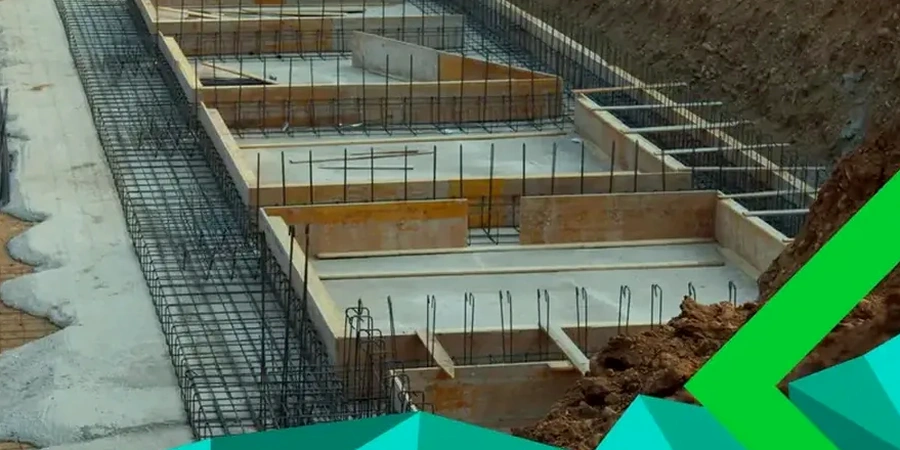
Arlington sits squarely on the Eagle Ford Shale and overlying expansive clay formations that give foundation engineers across the Metroplex real headaches. We see plasticity indices in the 30 to 50 range routinely, which means seasonal moisture swings can lift and drop a poorly designed footing by a couple of inches before anyone notices a crack. A proper shallow foundation design here has to lock in on two questions: what bearing pressure the clay can carry at its worst moisture condition, and how deep you have to go to get below the active zone. Our lab runs consolidated-undrained triaxial tests, one-dimensional consolidation, and Atterberg limits on every site, feeding parameters straight into bearing capacity calculations and settlement predictions under ASCE 7 load combinations. When we encounter fill or questionable near-surface material, we often pair the investigation with test pits so we can log the contact between natural ground and any urban fill that got dumped during subdivision grading decades ago.
On Arlington's expansive Eagle Ford clay, settlement-controlled design usually governs long before bearing capacity becomes the limiting factor.
Methodology and scope
Arlington's population passed 394,000 in the last census, and the construction pace hasn't slowed much since. Most residential work defaults to slab-on-grade foundations, but the real engineering happens on the commercial pads and tilt-wall warehouses going up along the I-20 and SH-360 corridors. Those projects demand shallow foundation design that reconciles column loads of 200 to 400 kips with a subgrade that can lose half its undrained shear strength between May and August. We typically run bearing capacity models using both general shear failure criteria and, more critically, settlement-controlled allowable pressures because the clays here rarely fail by punching — they fail by excessive differential movement. Our lab performs incremental load oedometer tests to nail down the compression index and recompression ratio, then we model total and differential settlement under the actual loading footprint. The IBC requires a minimum factor of safety of 3.0 against bearing failure, but Arlington's amendment history has pushed many engineers toward 3.5 on sites with mapped shrink-swell potential. We also check the depth of seasonal moisture fluctuation using suction profiles from local NRCS soil survey data, tying it back to the Unified Soil Classification from ASTM D2487 logs.
Local geotechnical context
Arlington's climate swings from bone-dry August heat to spring storm seasons that can dump four inches of rain in a weekend. That cycle is the enemy of shallow foundations here. A footing designed solely for bearing capacity on a sample taken during a dry summer will look great on paper, but when the clay rehydrates after a wet winter, the undrained shear strength can drop enough to double the calculated settlement. The other hazard we track closely is differential heave across a single building pad. Trees are a factor in older neighborhoods like the ones near the University of Texas at Arlington campus: a mature live oak can pull enough moisture from one corner of a slab to create a half-inch elevation difference within a single season. We mitigate this by specifying moisture-conditioned subgrade preparation, deepened perimeter beams, and in some cases, under-slab vapor barriers that double as capillary breaks — all integrated into the shallow foundation design from the start rather than treated as an afterthought.
Quick answers
How deep do footings need to go in Arlington's clay soils?
The IBC sets a minimum of 12 inches for undisturbed bearing, but across Arlington we almost never stop there. The active zone in the Eagle Ford clay can extend 15 to 20 feet deep, though most seasonal movement concentrates in the top 5 to 8 feet. Our designs typically specify footing bottoms at 24 to 36 inches below finished grade, which gets you below the worst of the moisture fluctuation and into a more consistent moisture and strength regime.
What does a shallow foundation design report cost for a typical Arlington commercial lot?
For a standard commercial pad with exploratory borings, lab testing, and a signed bearing capacity and settlement report, the fee generally falls between US$1,820 and US$2,960 depending on the number of borings and the lab program required. Sites with complex fill history or deep soft zones that need consolidation testing push toward the upper end.
Can you design shallow foundations on fill without removing it all?
Sometimes, but it's a case-by-case call. If the fill is documented, granular, and has been in place for years with no distress in adjacent structures, we can run in-situ density tests and possibly design on it after proof-rolling and recompaction. When the fill is older, undocumented, or contains organics, we typically recommend over-excavation down to natural ground and engineered replacement — it's the only reliable way to control differential settlement under a shallow foundation in Arlington conditions.