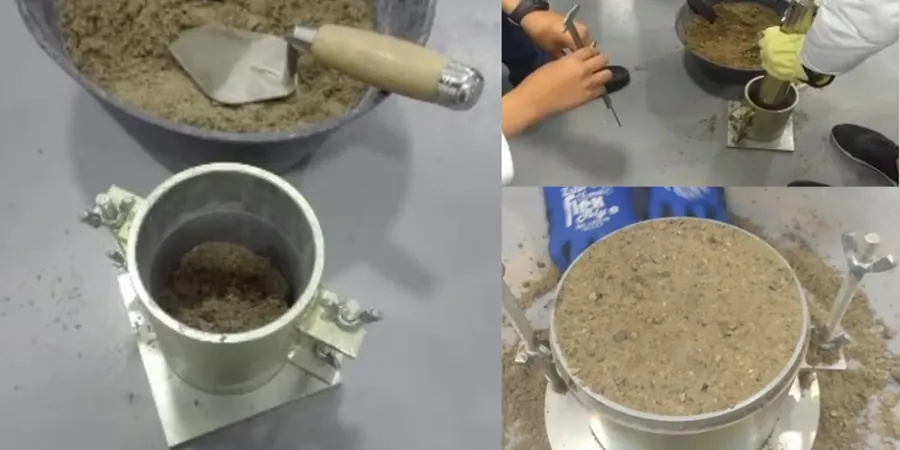
In Arlington we see many residential and commercial projects where uncontrolled fill causes settlement cracks within the first year. The Proctor test determines the optimum moisture content and maximum dry density for a given compactive effort. Without this baseline, you cannot specify a target density or verify field compaction. We perform both Standard (ASTM D698) and Modified (ASTM D1557) Proctor tests in our lab. The choice between them depends on the expected traffic load and the depth of the fill. For a typical subdivision roadway, Standard energy is enough. For a heavy truck dock or a parking garage ramp, Modified Proctor matches the higher compactive effort that rollers will apply. We also run field density tests via the sand cone method on the same day to compare field moisture and density against the Proctor curve. The result is a clear pass/fail criterion for each lift.
A Proctor curve that misses the saturation line by 2% can lead to a fill that never reaches 95% of maximum density under field conditions.
Methodology and scope
Arlington sits on a mix of Piedmont residual soils and coastal plain sediments. The residual clay-silt mantles are often moist and prone to clod formation during compaction. The Proctor test in our lab accounts for this by using a 4-inch or 6-inch mold and a specified number of blows per layer. For Standard Proctor (ASTM D698) we apply a 5.5-lb hammer falling 12 inches. For Modified Proctor (ASTM D1557) we use a 10-lb hammer with an 18-inch drop. The higher energy breaks down larger clods and simulates heavy equipment. We always run a minimum of five points to define the curve and re-run the saturation line when the soil is above optimum. Before selecting the compaction method, we recommend a complementary Atterberg limits test to determine the soil's plasticity and its sensitivity to moisture changes. The data helps us advise on the target moisture range and the number of roller passes required for each zone of the site.
Technical reference image — Arlington
Local considerations
Arlington's rapid suburban growth over the last two decades has pushed development onto former farmland and forested slopes. Many of these sites contain undocumented fill from the 1960s and 1970s. Without a site-specific Proctor test, contractors often use a generic value from a soil survey, which can be 5–10 pcf off from the actual material. The risk is easy to overlook: a fill that appears firm but is only at 88% of Standard Proctor will consolidate under its own weight and under building loads. We have seen garage slabs drop 3 inches in two years because the subgrade compaction was never verified against the correct curve. A Proctor test from the actual borrow source eliminates that guesswork.
Five-point compaction curve with optimum moisture and maximum dry density for light to moderate traffic fills. Includes sample preparation by the wet or dry method.
02
Modified Proctor (ASTM D1557)
Higher energy curve for heavy-load applications — airport aprons, container yards, and deep structural fills. Uses the 10-lb hammer and 18-inch drop.
03
Field Density Verification
Sand cone or nuclear gauge testing on each lift. We compare in-place density against the Proctor curve and issue a compaction report with percent of maximum density.
04
Moisture-Density Adjustment
If the field moisture is 3% above optimum, we recommend aeration or blending with dry material. We re-run the Proctor on the adjusted blend before re-testing in the field.
What is the difference between Standard and Modified Proctor tests?
The Standard Proctor (ASTM D698) uses a 5.5-lb hammer falling 12 inches, applied in 3 layers. The Modified Proctor (ASTM D1557) uses a 10-lb hammer falling 18 inches, applied in 5 layers. Modified Proctor simulates heavier compaction equipment and typically yields a higher maximum dry density and a lower optimum moisture content. Use Modified when the fill will support heavy traffic or deep foundations.
How much does a Proctor test cost in Arlington?
A typical Standard or Modified Proctor test in Arlington ranges from US$100 to US$210 per sample, depending on the number of points, the need for re-runs, and whether the sample needs drying or crushing. Volume discounts are available for multi-borrow-source projects.
Can you run a Proctor test on a sample that contains gravel or cobbles?
Yes, but the sample must be scalped through a No. 4 sieve (4.75 mm). Oversize particles are removed, and the moisture-density curve is adjusted using the oversize correction method (ASTM D4718). We report both the corrected and uncorrected curves, and we note the percentage of oversize material in the report.