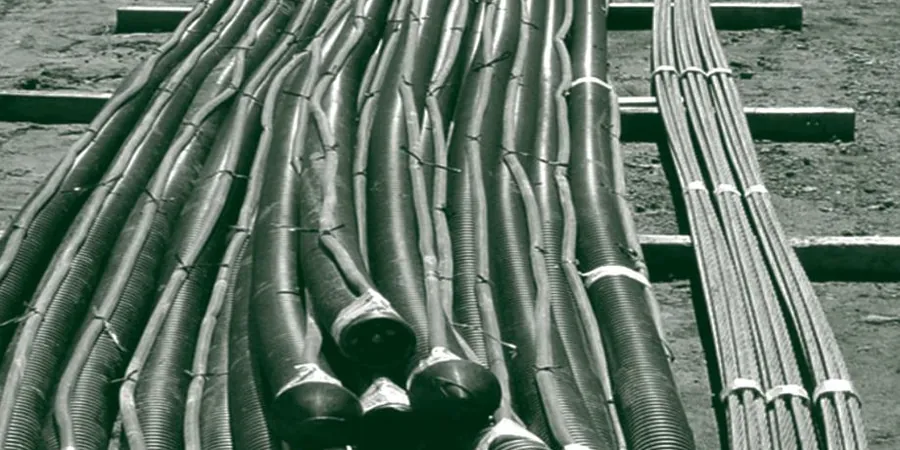
A common mistake we see among contractors in Arlington is assuming that any tieback or soil nail can handle the lateral loads of a 30-ft excavation without a proper anchor design. The geology here, dominated by Eagle Ford Shale and interbedded claystone, behaves very differently under sustained tension than a granular soil would. If you design a passive anchor where an active prestressed element is required, the wall creeps and the excavation loses its shoring tolerance. That is why our team always starts with a site-specific load test and a review of the permeability of the soil profile to confirm drainage conditions before finalizing the anchor bond length.
In Arlington, bond length governs anchor capacity more than tendon strength. We verify bond stress with field pull tests before locking the load.
Methodology and scope
The difference between designing anchors for a project near Lake Arlington versus one along the I-30 corridor is substantial. The lake-area soils have higher moisture content and lower undrained shear strength, which forces us to use longer bond zones and active prestress to lock in the load. Along I-30, the residual claystone can support higher bond stresses, so passive anchors with corrosion-protected strands often suffice. In both cases we complement the design with a CBR test for the subgrade to verify the bearing stratum and a georadar survey to map buried utilities before drilling. Without these checks, the anchor alignment may hit obstructions or lose grout into voids.
Technical reference image — Arlington
Local considerations
The summer heat in Arlington, with pavement temperatures exceeding 120°F, accelerates grout shrinkage in anchor bond zones if the mix is not retarded properly. During the spring wet season, perched water tables in the claystone cause the borehole to collapse before the tendon is inserted. We mitigate this by using a temporary casing and a low-slump grout with a set-retarder admixture. Ignoring these seasonal effects leads to bond strength reductions of up to 30%, which directly compromises the anchor’s long-term performance. Every anchor design we produce for Arlington includes a risk assessment table that flags these thermal and hydric conditions.
For excavations deeper than 25 ft or where lateral displacement is critical, we design active anchors with post-tensioned strands. The bond zone is calculated from SPT N-values and laboratory shear strength, and we specify a lock-off load that prevents creep in the Eagle Ford Shale.
02
Passive Tieback & Soil Nail Design
For temporary shoring or lower headroom conditions, passive anchors and soil nails are designed with a factor of safety of 1.5 against pullout. We verify bond stress using the FHWA empirical method and recommend double-corrosion protection for exposure classes C2 and above.
03
Anchor Field Verification & Load Testing
We supervise proof-load tests on 5% of production anchors per IBC 2021, recording load versus displacement curves. The acceptance criterion is based on the residual displacement after lock-off, which must not exceed 0.1 in. at 1.33× the design load.
Applicable standards
FHWA-NHI-13-026 (Ground Anchors and Anchored Systems), ASCE 7-22 (Minimum Design Loads, Section 12.13 – Soil Nail and Anchor Walls), ASTM D1586-18 (Standard Penetration Test for bond zone characterization), ASTM D4320-04 (Standard Practice for Laboratory Preparation of Chemically Grouted Soil Specimens)
Frequently asked questions
What is the difference between an active anchor and a passive anchor in Arlington soils?
An active anchor is prestressed to a lock-off load after installation, which preloads the soil and prevents movement before the excavation is complete. A passive anchor (or soil nail) is not prestressed; it only resists load after the soil has already moved slightly. In Arlington's claystone, active anchors are preferred for cut depths over 30 ft because the claystone creeps under sustained load, and prestress compensates for that creep.
What bond stress values do you use for anchor design in Eagle Ford Shale?
We use a bond stress of 0.8–1.2 MPa for temporary anchors and 0.5–0.8 MPa for permanent anchors in Eagle Ford Shale, based on the FHWA bond stress correlation with SPT N-values. For design, we apply a reduction factor of 0.7 to account for the fissured nature of the shale and potential water infiltration. These values are always verified with a field pull test before production.
How does the high plasticity of Arlington's clay affect anchor corrosion protection?
The claystone in Arlington has a plasticity index ranging from 25 to 45, which means it retains moisture and has low resistivity. Aggressive corrosion conditions (exposure class C2 or C3 per PTI) require double corrosion protection: a greased and sheathed tendon inside a corrugated plastic duct, with the annulus filled with cement grout. We specify Class I protection for all permanent anchors per FHWA guidelines.
What is the typical cost range for an anchor design and verification project in Arlington?
For a typical 30-anchor project with design, bond zone calculations, and field load testing of 2 anchors, the cost ranges between US$1.010 and US$3.650. This includes the geotechnical report, anchor layout drawings, and a pull-out test report. Costs increase if the site requires coring through rock or if multiple proof tests are needed per IBC.
Do you provide anchor design for temporary shoring or only permanent installations?
We design both temporary and permanent anchor systems. For temporary shoring (service life under 18 months), we use a factor of safety of 1.5 and single corrosion protection. For permanent tiebacks, we apply a factor of safety of 2.0 and double corrosion protection. All designs comply with IBC 2021, ASCE 7-22, and the FHWA manual for ground anchors.
Location and service area
We serve projects across Arlington and its metropolitan area.