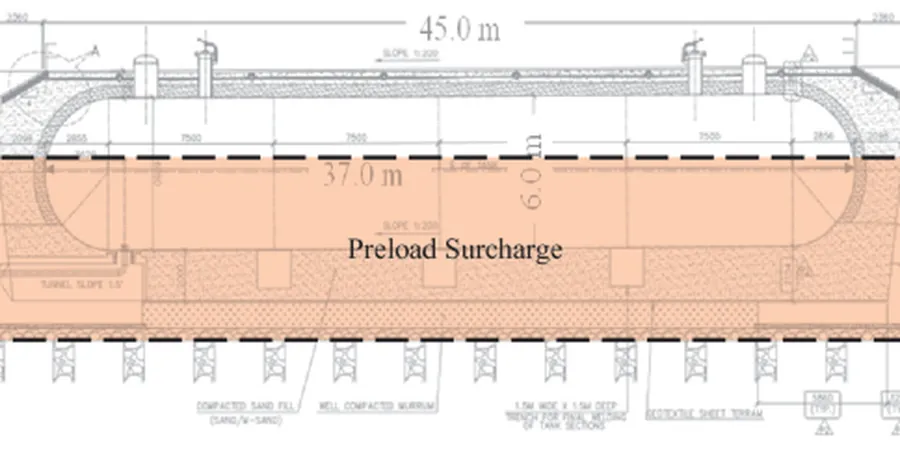
Soils in Arlington vary sharply between the alluvial clays near the Trinity River and the sandy terrace deposits south of I-30. The eastern sectors show high plasticity clays that require staged fills, while western developments rest on more permeable strata. This contrast makes preloading design a critical step before slab-on-grade or utility work. Our approach focuses on monitored fills without surcharge, relying on precise settlement plate data to control post-construction movements. For sites near the river corridor, we combine the preloading plan with a study of Atterberg limits to classify soil behavior, and then cross-check consolidation parameters with field permeability tests to verify drainage paths.
Preloading without surcharge in Arlington's fat clays requires staged fills and continuous settlement monitoring to match the final structural load.
Methodology and scope
Arlington sits at an elevation of about 610 feet, with a subtropical humid climate that keeps moisture content high in the upper clay layers. Annual rainfall near 36 inches drives seasonal swelling, making preloading design essential for warehouses and retail pads. The process applies a temporary fill matching the final load, without extra surcharge, and monitors pore pressure dissipation until 90% consolidation is reached. This method suits the city's expansive soils because it avoids overstressing the foundation subgrade. We also integrate a georadar survey to map shallow anomalies before placing fill, and use instrumentation with piezometers to track real-time pore pressures during the preloading period.
Technical reference image — Arlington
Local considerations
IBC 2021 and ASCE 7-22 require that foundation movements remain within serviceability limits. In Arlington, the primary risk is differential settlement caused by variable clay thickness. Preloading without surcharge reduces this risk by consolidating the weak layer before construction. However, if the fill is removed too early, secondary compression may reactivate movements. We follow the consolidation curve until the rate of settlement drops below 2 mm per month, a criterion adapted from FHWA recommendations for preloaded sites without surcharge. Neglecting this step leads to cracked slabs and misaligned utilities.
Staged fill placement with settlement plates, pneumatic piezometers, and survey control. We calculate the required fill height from the design load and track consolidation until 90% is reached. No surcharge is added, reducing fill volume and removal costs.
02
Post-Preloading Verification
After fill removal, we run plate load tests and shallow CPT to confirm that the achieved settlement matches predictions. A final report documents the settlement curve, pore pressure history, and residual movement projections for the structural engineer.
Applicable standards
IBC 2021 – Chapter 18 (Soils and Foundations), ASCE 7-22 – Serviceability requirements for differential settlement, ASTM D2435 / D4186 – Consolidation test procedures, FHWA NHI-05 – Preloading and vertical drains manual
Frequently asked questions
How does preloading without surcharge differ from surcharged preloading?
Surcharged preloading uses extra fill above the design load to accelerate consolidation, then removes it before final construction. Without surcharge, the fill height equals the final load exactly. This avoids overstressing the subgrade and reduces fill removal, but requires longer monitoring since consolidation rates are slower. In Arlington's clays, the no-surcharge approach is preferred when the schedule allows 4 to 8 months of waiting.
What is the typical cost range for a preloading design study in Arlington?
A complete preloading design study including field monitoring, settlement analysis, and final report ranges between US$710 and US$2,150. This covers instrumentation installation, weekly readings for up to 6 months, and a consolidation analysis report. Costs vary with site size and number of monitoring points.
When should I consider vertical drains instead of plain preloading?
Vertical drains (wick drains or sand drains) are used when the clay layer is thicker than 6 meters or when the available preloading time is under 3 months. They shorten drainage paths and accelerate consolidation significantly. Plain preloading without drains works well for thinner clay deposits (1 to 4 m) that are typical in Arlington's western terrace areas.
Location and service area
We serve projects across Arlington and its metropolitan area.